
custom_tlvs
sent as a list instead of an object, a sender ID that was never approved. All of those fail here,
where you can see the gateway’s own words, rather than in your code at three in the morning.
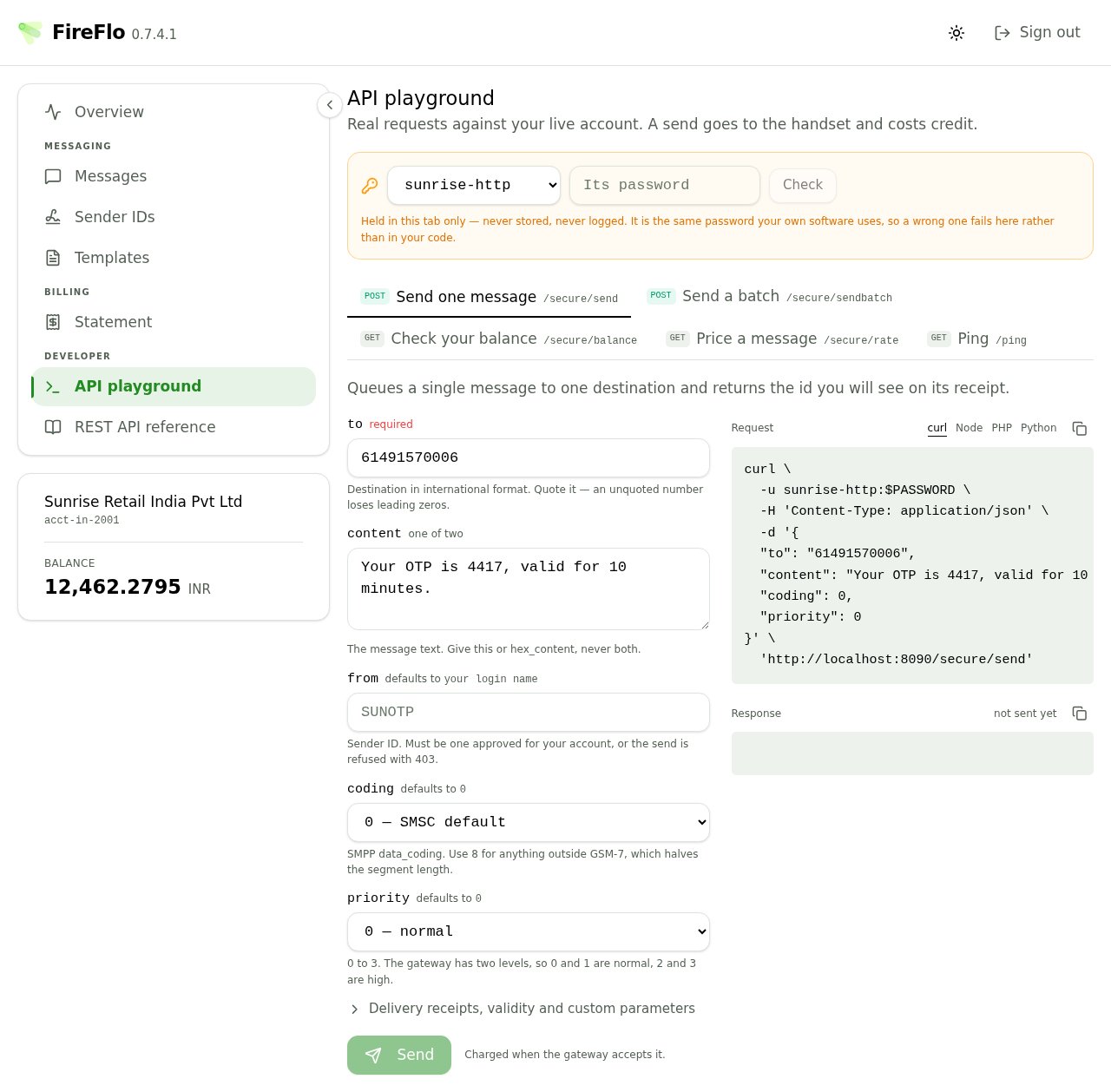
The playground, with the request built in the language of your choice from your own base URL and login. The password lives in the tab and nowhere else.
Connecting
Pick an API login and enter its password. It is checked against the gateway before anything else is enabled, and a wrong one is refused in the gateway’s own words rather than the panel’s guess.Held in this tab only — never stored, never logged. It is the same password your own software uses, so a wrong one fails here rather than in your code.Only HTTP logins can use this API. An SMPP login is refused with an authentication failure that reads exactly like a wrong password.
The five endpoints
Every field is labelled with its wire name, tagged required or optional with its default, and carries
a one-line note. Several of those notes exist because of a specific mistake:
to— quote it. An unquoted number loses its leading zeros.content— give this orhex_content, never both.from— must be one approved for your account, or the send is refused. The picker offers only approved sender IDs; pending ones are deliberately absent, because offering one you cannot yet use would produce a refusal the form could have predicted.coding— use 8 for anything outside GSM-7, which halves the segment length.validity_period— whole minutes, not a duration string.
custom_tlvs has a row editor, because the JSON shape is the single most common integration error:
Extra SMPP parameters as a JSON object — {"0x1401": "…"} — not a list of pairs and not a quoted
string.
The editor also warns when two rows name the same tag: the gateway refuses the whole request rather
than choosing one for you.
Reading the response
The response panel gives you the HTTP status, the round-trip time, and — the useful part — a plain-English explanation of what the status means. “Your prepaid balance will not cover the message. Nothing was sent or charged.” is more actionable than a bare 402. Where a send succeeded, the message id is offered with a copy button. That id is what will appear on the delivery receipt and in your message list. Alongside, a Request panel shows the same call as curl, Node, PHP or Python, filled in with your own base URL and login. Copy it straight into your code. The last few calls are kept in a small history you can reload into the form. It lives in the tab and dies with it.Batches
The batch endpoint takes a JSON list, and the textarea refuses to send malformed JSON rather than letting the gateway reject it.The reference alongside it
The REST API reference in the same section documents every endpoint, filled in with your account’s own values, plus delivery receipts, batch callbacks, the shared error table and the custom TLV grammar. It also handles credential rotation — replacing a password or API key yourself, with the new value shown exactly once.After rotating, the gateway reloads credentials on a timer. For roughly the next half minute your
old credential still works and the new one does not yet. The page tells you how long to wait.Where an API key doubles as the username, rotating it changes the username too — so both halves of
your configuration have to change together, and there is no grace period.